
Emergency Water Damage Restoration Near Me: What Bardonia Homeowners Should Do First
If you have active water damage in your Bardonia home right now, the first thing to do is stop the water at its source, then cut power to the affected area if you can reach the breaker without standing in water. After that, call a restoration company with live 24/7 dispatch at (914) 809-9936, and take photos of everything before you move a single item. The thirty minutes between discovering the damage and the crew arriving are the most consequential of the entire job, and most homeowners spend them doing things that make the damage worse.
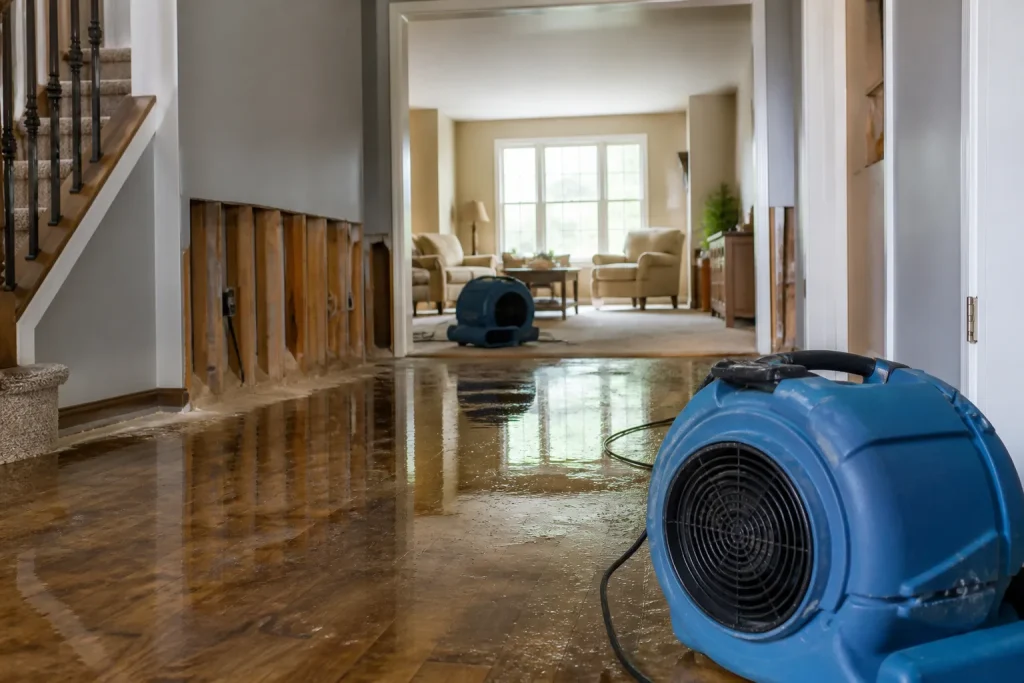
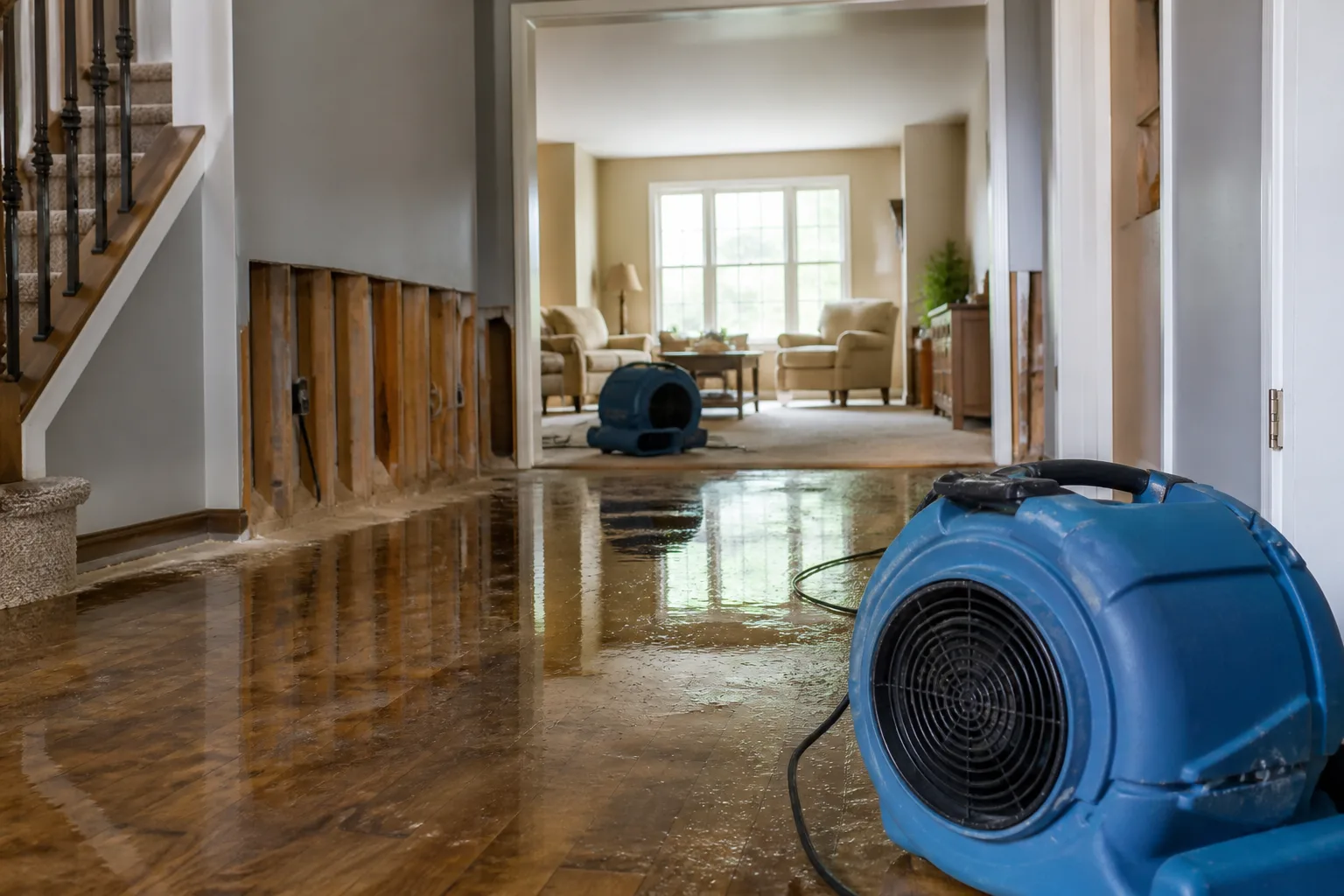
Putting towels down on a flooded floor is one of the most common first responses, and one of the most counterproductive. Saturated towels hold water against a subfloor for hours longer than if you’d left it alone, and they give you a false sense that the situation is under control while the water migrates laterally into wall cavities. If you’d rather not manage this yourself, call (914) 809-9936 now and a live dispatcher will get a crew moving toward your street.
What to Do in the First 30 Minutes: A Time-Stamped Sequence
Most “what to do first” lists online were written to generate a phone call, not to actually limit damage. The order of operations matters more than most people realize. Here is the sequence we train our crews around, and the one we recommend to every Bardonia homeowner who calls us while standing in a wet basement.
0-5 minutes: Stop the source. If the water is coming from a burst supply line, shut the valve at the fixture. If it’s the water heater, shut the cold-water inlet on top of the tank. If it’s an appliance, cut its dedicated circuit if you know which one it is. If you don’t know where the main shutoff is, find it now, before you need it in a panic. In most Bardonia homes with municipal water, the main valve is in the basement or crawlspace near the front foundation wall.
5-15 minutes: Cut power safely. Water and electricity are a lethal combination. If the breaker panel is dry and you can reach it without stepping in water, shut off circuits to the affected rooms. If the panel is wet, or the path to it goes through standing water, do not touch it. Call an electrician, or let the restoration crew coordinate that when they arrive. We have seen homeowners wade through an inch of water to flip a breaker, and it is never worth the risk.
15-30 minutes: Document, then call. Use your phone camera. Photograph the source, the standing water, the affected rooms, the water line on drywall, and anything that got wet. These photos matter for insurance, and they matter for the restoration company. A restoration company that knows what it is looking at before dispatch can send the right equipment on the first truck.
The Call Matters: What to Actually Say to Dispatch
When you call an emergency restoration line in or near Bardonia at 2 a.m., you should be able to tell within thirty seconds whether you are talking to a dispatcher or an answering service. The difference determines whether extraction equipment starts running tonight or tomorrow morning.
Ask these three questions:
- “Are you dispatching a crew right now, or taking a message?” A legitimate 24/7 restoration company has a live person who can dispatch. An answering service says they will have someone call you back.
- “What time will the crew arrive?” A real dispatcher gives you a window. A vague answer means the crew is not actually on the board yet.
- “Who am I talking to?” If the person cannot tell you which company they work for and where they are located, you are probably talking to a national call center routed through three states.
When describing the loss, be specific. The difference between “my basement is wet” and “I have standing water over the slab, source is the water heater, I estimate 400 square feet” determines what truck gets dispatched. The first description gets you a generalist with a shop vac. The second gets you a truck with extraction units made by XPOWER and air movers sized to the square footage. Water damage in Bardonia homes is not all the same, and the first call should not treat it like it is.
What Not to Do: Three Mistakes That Make It Worse
Every restoration crew in Rockland County has walked into a home where the homeowner made things harder before we got there. Here are the three we see most often in Bardonia basements and kitchens.
Don’t shop-vac Category 2 or Category 3 water. Category 1 is clean water from a supply line. Category 2 is gray water from a dishwasher, washing machine, or sump pump failure. Category 3 is black water, meaning sewage or floodwater. A shop vac on Category 2 or 3 water aerosolizes bacteria and spreads contamination into the air and onto surfaces that were never wet. If the water has any odor, or if it came from a drain line, leave it alone and let us handle it with the right containment.
Don’t run the HVAC to “dry things out.” Your central air system does not dry a flooded room. What it does is pull moisture into the ductwork and distribute it through the house. That moisture settles in wall cavities, behind baseboards, and under flooring in rooms you did not think got wet. We have seen a single wet basement in Bardonia turn into a whole-house humidity problem because the homeowner ran the fan overnight.
Don’t move wet contents to the garage without documenting. The insurance adjuster needs to see where things were and what they looked like wet. Moving a soaked sofa to the garage “to save it” removes evidence, and often the garage floor becomes a second loss site. Take photos first, then move things if you must.
What Water Does Where You Can’t See It
Bardonia homes built in the 1960s through the 1980s share certain construction patterns. Engineered hardwood over OSB subfloor. Spray-foam insulation in rim joists. Drywall that wicks water up from the baseplate. Each of these materials absorbs water in ways a homeowner cannot judge by touch.
OSB subfloor swells and loses structural integrity when saturated, but the top surface can feel dry after an hour of a fan blowing across it. The moisture is in the core, not on the surface. Engineered hardwood delaminates at the seams, but that failure can take days to show. Spray-foam insulation in a rim joist can hold water against the sill plate for weeks, quietly rotting the wood behind it.
This is why professional moisture meters matter. At Floodline Restoration Co., every Bardonia job starts with a moisture map. We use professional-grade equipment from brands like Dri-Eaz, Injectidry, and B-Air, and we log daily readings until the dry standard is met. A homeowner with a wet finger and a box fan cannot tell the difference between 15% moisture and 28% moisture. Our meters can, and we hand the log to the homeowner and the insurance carrier at the end of the job.
What a Legitimate 24/7 Emergency Response Actually Looks Like
When we say we answer the phone with a live person at 2 a.m., we mean a dispatcher who can put a crew on the board that minute. Not an answering service. Not a voicemail. Not a “we’ll call you back in the morning.” Water does not wait for business hours, and Bardonia basements do not dry themselves overnight.
Here is what happens on a legitimate emergency call to Water Damage Restoration in Bardonia:
- A live dispatcher answers, takes the address, and confirms the nature of the loss.
- The dispatcher alerts the on-call certified crew and gives an arrival window.
- The crew arrives in uniform, confirms the scope, and starts extraction on that same visit.
- Moisture mapping begins on day one with professional meters, not guesswork.
- Drying equipment gets set to the specific square footage and materials affected.
- Daily readings get logged until the structure meets the dry standard.
That last point matters. IICRC standards are a defined threshold, not a vibe. A crew that sets fans and disappears is not doing restoration. A crew that reads moisture daily, adjusts equipment placement, and hands you a log is doing the job the way it is supposed to be done.
We pulled one out of a garage over in the Bardonia Hills development last winter where the homeowner had already spent three days running two box fans from the hardware store. The concrete slab looked dry. The water had traveled under the drywall and into the adjoining den’s subfloor. The final bill from the box-fan approach was about nineteen thousand dollars more than it would have been if we’d been called on day one.
When to Call a Pro
You can handle a small spill from a known clean-water source if you catch it immediately and the area is truly dry within 24 hours. Anything beyond that, call someone who does this every day.
Call (914) 809-9936 if any of these apply:
- Standing water covers more than a few square feet.
- The water came from a drain, toilet, sump pump, or anything that is not a clean supply line.
- Water has been sitting for more than a few hours.
- Water has touched drywall, insulation, or finished flooring.
- You smell anything musty, sour, or sewage-like.
- You are not sure where the water is coming from, or you cannot stop it.
Related services in Bardonia: Mold Remediation in Bardonia - because mold starts growing within 24 to 48 hours of water exposure, and Floodline Restoration Co. home - the full-cycle restoration company that handles the whole job.
The Bottom Line
The first thirty minutes of a water event in a Bardonia home determine how much of the house has to be torn out. Stop the source, cut power safely, document with photos, and call a company with live dispatch at (914) 809-9936. Do not shop-vac questionable water, do not run the HVAC, and do not rely on towels. Get a crew with professional meters and certified technicians on the way, and let them handle it from the floodline to the finished rebuild.
At Floodline Restoration Co., we have been serving Bardonia and the surrounding Rockland County communities for over 42 years, founded in 2010 by Curt Bowman and built around a dispatch board, not a sales desk. We answer the phone with a live person at all hours, most jobs are completed in a single visit, and we bill your carrier directly. If you are in Bardonia and need help, Floodline Restoration Co. offers free estimates. Call (914) 809-9936 and a real person picks up.
Frequently Asked Questions
Floodline Restoration Co. has live dispatch 24/7, meaning a dispatcher answers the phone at any hour and puts a certified Bardonia crew on the board immediately. The crew reaches the job and extraction is running on that same visit in most cases. Call (914) 809-9936 and the dispatcher will give you an honest arrival window, not a callback promise.
Homeowner policies generally cover sudden and accidental water damage, like a burst supply line or a failed water heater, but not gradual leaks or long-term seepage. Floodline Restoration Co. bills your carrier directly and documents the loss with photos and daily moisture readings, so you’re not playing messenger between your insurance company and the restoration crew.
Household fans move air across surfaces and dry only what they touch. Water in a Bardonia home migrates into wall cavities, under baseboards, and inside OSB subfloor where surface airflow cannot reach. Professional equipment like Injectidry mats, XPOWER air movers, and Dri-Eaz dehumidifiers pulls moisture from inside materials, and moisture meters confirm the dry standard was met. Calls are free: (914) 809-9936.
Floodline Restoration Co. gives the 90-Day Done Right Promise in writing on every job. If it is not done right, we make it right, no arguing and no paperwork battles. It is built on the K.E.Y.S. values code: Krafted right, Every time, Your home first, Standing behind it. That is the Keystone Standard, and it is why the company has served Bardonia for decades.
Written by Curt Bowman, Owner at Floodline Restoration Co., serving Bardonia since 2010.
Need Damage Restoration Help?
Call Floodline Restoration Co. - licensed & insured, here with fast after-hours help in Bardonia.
(914) 809-9936