
Dri-Eaz Water Damage Restoration in Bardonia: A Homeowner’s Guide
A Dri-Eaz LGR 3500i can pull 35 gallons of water out of the air per day, but only if it’s placed in the right location, set to the right mode, and moved on the right schedule. Most Bardonia homeowners never see the placement map or the daily moisture readings, which means they have no way to know if the drying is actually working. This guide explains what Dri-Eaz equipment does, what the numbers on its readout mean, and how to verify the crew is using it correctly. If you’d rather skip the technicals and just get the water out, call (914) 809-9936.
Here’s the thing about water damage in Bardonia that most restoration marketing never mentions: the brand name on the dehumidifier matters far less than whether the technician running it knows how to read its data logs. A cheap box-store dehumidifier placed correctly will outperform an LGR 3500i placed wrong. The equipment is only as good as the person positioning it, monitoring it, and interpreting what the sensors say. That’s the standard we hold at Floodline Restoration Co., and it’s the standard you should expect from any crew that walks into your home with a Dri-Eaz unit on a hand truck.
What LGR Technology Actually Does (In Plain Terms)
LGR stands for Low Grain Refrigerant. A grain, in this context, is a unit of moisture measurement, about 1/7,000th of a pound of water vapor per pound of dry air. A standard hardware-store dehumidifier pulls moisture until the air in the room reaches a certain relative humidity, maybe 40 or 50 percent, then it plateaus. An LGR unit keeps pulling well past that point because its internal coils run colder and its refrigerant is engineered to handle lower vapor pressure. It can drive the air down to the low 20s or teens in grains per pound, which is what a water-damaged wall cavity actually needs to release the moisture trapped in drywall, studs, and insulation.
When a pipe bursts in a Bardonia split-level and soaks a wall cavity, the wood framing can hold moisture at 25 to 30 percent moisture content. The air around it needs to be bone dry, drier than desert air, to create what the industry calls a vapor-pressure gradient. That’s the force that pulls water out of the wood and into the air, where the dehumidifier captures it. A hardware-store unit cannot create that gradient. An LGR unit can, but it needs time, proper airflow, and sealed containment to do it. We’ve watched homeowners in Bardonia run a $200 dehumidifier for two weeks and wonder why the baseboards are still swollen. The answer is always the same: the machine wasn’t capable of the pull required.
Here’s the breakdown of what LGR does differently:
- Drier output air: An LGR unit pushes air out at 10 to 15 percent relative humidity, versus 40+ percent for standard units.
- Lower grain depression: It can remove moisture from air that already feels dry to a human, which is exactly the air needed to dry structural materials.
- Efficiency gains: LGR units remove more water per kilowatt-hour of electricity, which matters when a job runs for five or seven days straight.
- Heat management: They run cooler than older desiccant or standard refrigerant units, so you’re not baking the interior of a Bardonia home in July while trying to dry it.
The realistic expectations for a properly placed Dri-Eaz LGR in a sealed, heated room are 25 to 40 pints of water per day. Not 35 gallons. That figure is the theoretical maximum under lab conditions with 90°F air and 80 percent relative humidity. A Bardonia basement in March is colder and drier going in, so the unit works slower. Knowing the difference between lab numbers and field results is something a competent technician explains, not something you should have to drag out of them.
How to Read a Dri-Eaz Moisture Log (And What the Dry Standard Numbers Should Be)
Every Dri-Eaz dehumidifier logs its operating data: inlet temperature, inlet relative humidity, outlet temperature, outlet relative humidity, grains per pound removed, and total water collected in the condensate tray. That data is accessible through the unit’s onboard display or via an app, depending on the model. What matters to you as a Bardonia homeowner is not the daily water total, it’s the trend line on the moisture content of the building materials, which the technician reads with a separate moisture meter and records on a log sheet or app.
The “dry standard” is the moisture content level at which the affected materials are considered dry enough to stop active drying and remove equipment. For dimensional lumber and framing in the Northeast, that number is typically 16 percent moisture content or below, matched against an unaffected control area of the same material in the same house. Drywall is different. Gypsum board should be below 1 percent on a penetrating meter, which effectively means “dry to the touch and reading at the low end of the scale.” Hardwood flooring in a Bardonia cape needs to be back within 2 to 3 percent of its pre-loss moisture content before you can safely refinish or reinstall anything over it.
Here’s what a daily moisture log should show, and what the numbers mean:
- Day 1 readings: Affected wall studs at 28 percent, control studs at 12 percent. The gap is the target.
- Day 3 readings: Affected studs at 22 percent. Trend is down, equipment is working, keep it running.
- Day 5 readings: Affected studs at 17 percent. Close, but not at the dry standard yet. One or two more days.
- Day 7 readings: Affected studs at 14 percent, within 2 points of control. Equipment removed, log handed over.
If the trend stalls, meaning two consecutive daily readings show no change, that’s a red flag. It means the equipment is placed wrong, the containment is leaking, the unit is undersized, or there’s a hidden water source still feeding the area. A sharp technician catches that on day 3, not day 6. Curt Bowman, our owner, has walked Bardonia job sites where a previous contractor had let a stall go for four days because nobody was reading the log. That’s four extra days of equipment cost, four extra days of inconvenience, and four extra days for mold to get a foothold.
Placement Is the Variable That Determines Whether Walls Dry in 3 Days or 7
This is the section where most Bardonia homeowners get misled, not by dishonesty, but by inexperience. The brand on the dehumidifier does not determine drying time. Placement does. You can have two identical Dri-Eaz LGR 3500i units in the same room, and one will dry the wall in three days while the other takes seven. The difference is entirely in where they sit, where the air movers point, and whether the affected area is properly sealed.
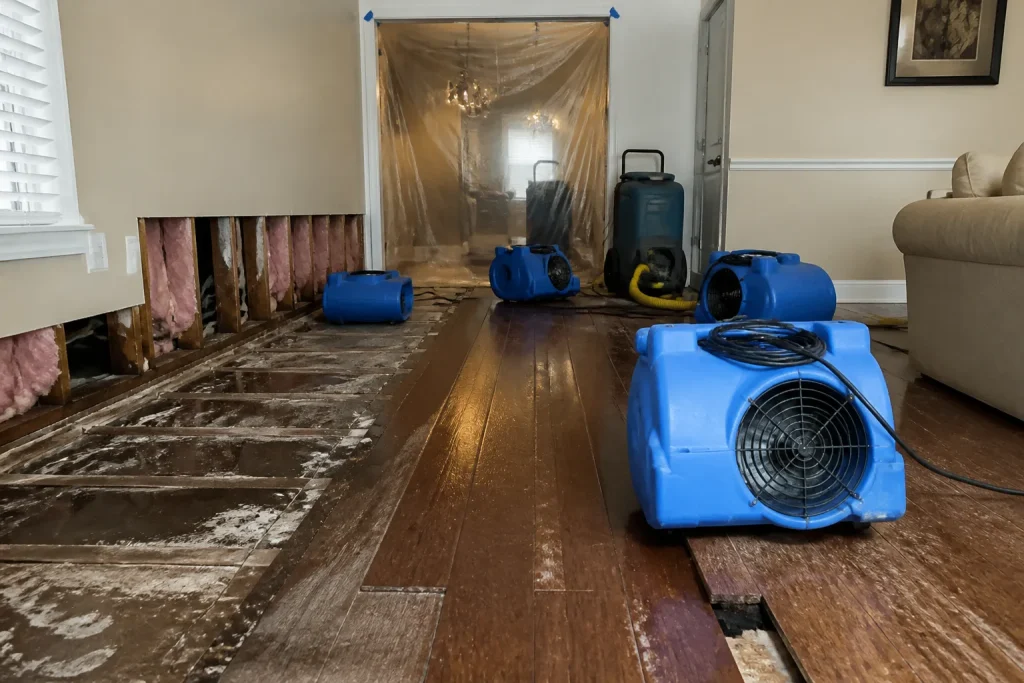
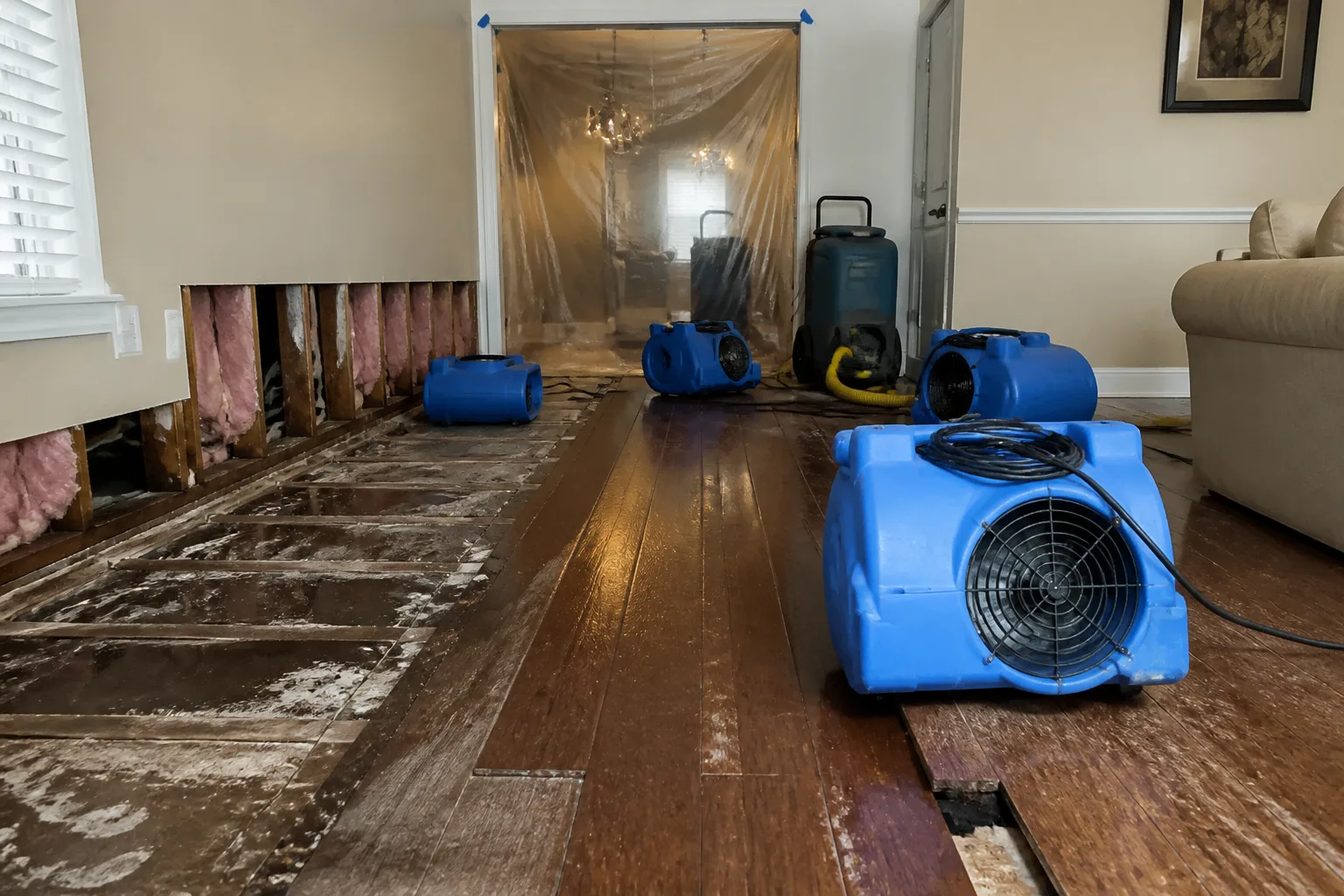
A correct placement map for a typical Bardonia basement flood looks like this: containment plastic or a zipper door sealing the affected area from the rest of the finished basement, one air mover per 10 to 14 linear feet of wet wall, air movers angled 15 to 45 degrees toward the wall to create a turbulent air wash across the surface, and the dehumidifier positioned centrally in the contained space with its dry air output directed into the airflow path, not shoved in a corner behind the furnace. That configuration creates what the industry calls a “drying chamber.” When the airflow is channeled correctly, the boundary layer of humid air that clings to the wet drywall gets stripped away continuously, and the LGR unit captures the moisture.
In Bardonia homes, the most common placement mistake we correct is leaving the dehumidifier in the middle of a large open area with no containment. The unit ends up trying to dry the entire floor, the stairwell, and the air in the adjacent rooms. It can’t. The vapor pressure gets diluted, the drying gradient collapses, and the job stretches out for a week or more. A second common mistake is pointing air movers directly at walls from across the room without any containment, which just stirs humid air around and slows the process further.
A proper placement map gets drawn before the equipment comes off the truck. Any technician worth hiring can show you a simple floor plan sketch with the unit locations, air mover arrows, and the daily reading points marked. If they can’t produce that map or can’t explain why the equipment is where it is, ask them to describe the airflow path. If they can’t do that either, call someone else. Placement is the entire game, and the map is the proof the game is being played correctly.
Which Dri-Eaz Model Matches Which Water Loss Size
Different water losses call for different equipment. Running a 3500i on a small residential pipe burst is like using a fire hose to fill a birdbath, overkill but manageable. Running a small LGR 2000 on a fully flooded Bardonia basement is worse: the unit runs continuously, can’t keep up, and the building materials never reach the dry standard. The job extends, the power bill climbs, and the homeowner starts to wonder if the contractor is stringing things along. Matching the unit to the loss is a basic competency test.
Here’s the practical breakdown for typical Bardonia water damage scenarios:
- Small pipe burst, one bathroom or a single wall cavity: A Dri-Eaz LGR 2000 or equivalent Phoenix unit, one or two air movers, drying in 2 to 3 days.
- Finished basement flood, 400 to 800 square feet affected: An LGR 3500i plus four to six air movers, proper containment, drying in 4 to 6 days.
- Category 3 sewage backup or a well pump failure that sat for a day: Extraction first, removal of porous materials, then a larger LGR like the 3500i or a Dri-Eaz DrizAir 1200, plus HEPA air scrubbers, drying and cleaning in 5 to 7 days depending on material removal.
The category 3 distinction matters. Sewage water carries bacteria, viruses, and whatever else was in the waste line. Drying equipment does not sanitize; it only removes moisture. A Bardonia homeowner with a sewage backup who tries to dry in place without removing carpet pad, drywall, and insulation is setting themselves up for a mold problem and a health hazard that no amount of LGR runtime will solve. The right equipment for category 3 includes extraction, controlled demolition, antimicrobial application, and then drying with LGR units and HEPA filtration. Using the wrong size or wrong sequence extends the job and, in some cases, makes it unsalvageable.
We’ve also used Injectidry systems on Bardonia jobs where hardwood floors got wet from above, like a dishwasher leak that ran under the kitchen floor and into the adjacent dining room. The Injectidry panels pull water out of the floor cavity through negative pressure while an LGR handles the ambient air. That combination saves floors that would otherwise need to be torn out. The point is that “professional-grade Dri-Eaz equipment” means a matched system, not just a single impressive-looking dehumidifier sitting in the middle of the room.
What Our Moisture Log Handoff Looks Like at Job Close
When the drying is done, you should receive a document that shows the daily moisture readings from day one to the final day, the dry standard used for each material type, the equipment that was on site, and the date and time each unit was removed. At Floodline, that document is part of our 90-Day Done Right Promise, which we put in writing on every Bardonia job. No arguing, no paperwork battles. If the drying was not done right, we make it right.
Why does that log matter six months later? Because mold claims have a way of surfacing after the fact. An adjuster or a secondary remediation company might question whether the original drying was adequate. That log is your proof that the readings were taken daily, that the dry standard was met before equipment was removed, and that the affected area was documented throughout the process. Without it, you’re relying on someone’s memory. With it, you have a record. We hand that log to the homeowner and the insurance carrier at the same time. You should never have to play messenger between the two, which is why we also bill the carrier directly on covered losses.
One more thing worth knowing: the dry standard is not the same as “feels dry.” A wall can feel dry to the touch at 20 percent moisture content and still be a mold risk if it stays there. The meter doesn’t care how it feels. Neither should you. The log is what tells you the job was finished, not the contractor’s hand on the wall and a confident nod.
When to Call a Pro
If the water came from a clean source, the affected area is small, and you have access to professional-grade equipment, drying in place is occasionally manageable. But if the water sat for more than 24 hours, if it came from a sewage line or an exterior flood, or if the affected area includes wall cavities, subfloor, or insulation, call a restoration contractor. The stakes go up quickly in Bardonia homes with finished basements, because the moisture gets trapped between the foundation wall and the drywall, and by the time it shows on the surface, the damage underneath is already advanced. Also, the extraction step matters as much as the drying. A pump and a wet vac will not remove the same volume as a truck-mounted extraction unit, and the water you leave behind is water the dehumidifier has to fight to remove.
Related services in Bardonia: Water Damage Restoration in Bardonia | Mold Remediation in Bardonia | Fire & Smoke Damage Restoration in Bardonia
The Bottom Line
Dri-Eaz equipment is professional-grade and performs well when it’s matched to the loss, placed correctly, and monitored daily. The equipment is not the variable that determines whether your Bardonia home dries in three days or seven. The technician is. A moisture log with daily readings is the document that proves the job was done, and it’s the document you want in your hands before you sign off on anything. If the crew can’t show you a placement map, can’t explain the dry standard, or can’t produce a daily reading log, find a different crew.
If you’re in Bardonia and dealing with water damage, Floodline Restoration Co. offers free estimates and a written 90-Day Done Right Promise on every job. We answer the phone with a live person, 24/7, and we’ll be there when we say. Call (914) 809-9936.
Frequently Asked Questions
Yes, in the sense that LGR technology pulls moisture from air that a standard unit leaves behind, which is what’s required to dry wood framing and drywall. The equipment difference matters, but placement and monitoring matter more. A well-placed standard unit will beat a poorly placed LGR on many jobs.
Most residential basement floods in Bardonia dry in four to six days with proper equipment placement, containment, and daily readings. Small pipe bursts can finish in two to three days. The log tells the truth; the timeline estimate is just a starting point.
Most homeowner policies cover water damage restoration from sudden and accidental events like a burst pipe or appliance failure, including the drying equipment cost. Floodline Restoration Co. bills the carrier directly on covered Bardonia losses, so you’re not fronting the money and waiting for reimbursement. Call (914) 809-9936 and we’ll help you sort out the coverage question on the first call.
Ask for the placement map and the daily moisture log. A competent restoration contractor will show you both without hesitation. The readings should trend downward day over day. If they stall or the contractor can’t produce a log, the job is not being monitored properly.
Written by Curt Bowman, Owner at Floodline Restoration Co., serving Bardonia since 2010.
Need Damage Restoration Help?
Call Floodline Restoration Co. - licensed & insured, here with fast after-hours help in Bardonia.
(914) 809-9936